What you actually gain by not assuming the worst — and when that's harder than it sounds.
Most people, when they sense threat in an organisation, tighten. They share less, answer more carefully, protect the edges of their work. It's understandable. It's also often the thing that confirms exactly what they were afraid of.
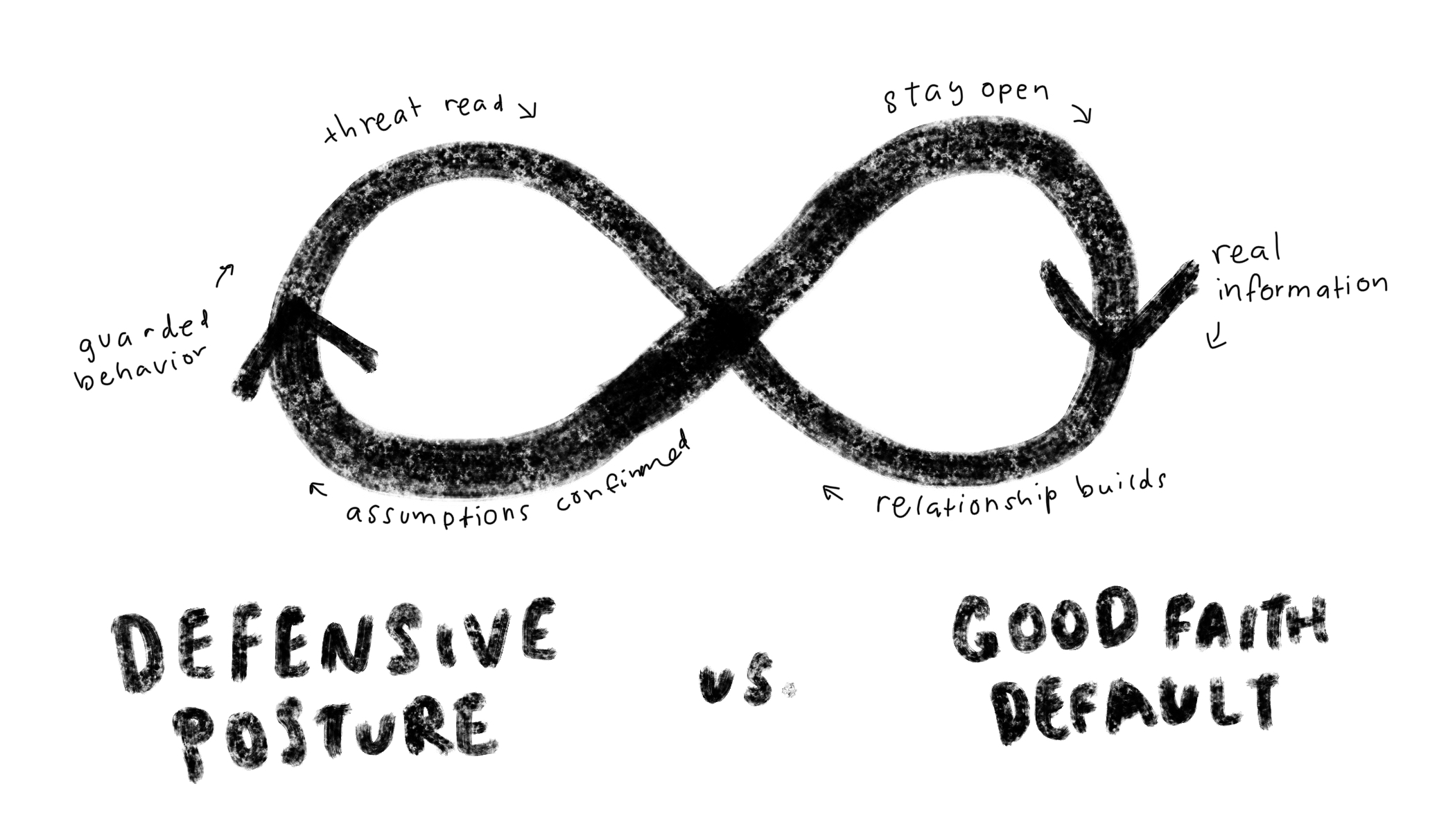
I've watched this play out in several organisations navigating difficult integrations. Someone interprets a cross-functional question about their team's capacity as a threat to take their work. They respond with tight, defensive answers. The questioner goes away with incomplete information, a slightly negative impression, and a reduced inclination to involve that person in future decisions. The person reads this reduced involvement as confirmation of their original threat assessment. The loop closes. Nothing has changed except that both people's worst assumptions about each other have been quietly validated.
What makes this pattern hard to interrupt is that the threat read is often not wrong. Acting from it is what creates the problem, not the assessment itself.
I've been thinking about this for a while, partly because I've held what I'd call a good faith default for most of my career — and I'm still working out when it helps, when it doesn't, and why it was probably easier for me to hold than it is for others.
What good faith posture actually means
It's not about being nice, or performing warmth you don't feel, or pretending a difficult colleague is someone other than who they are.
It's closer to this: assume good intent by default, even when your private read is more sceptical. Not to change what you think, but to stop that private read from contaminating how you show up before you have real information.
When you enter an interaction already guarded, reading ambiguous questions as extractions and neutral curiosity as territorial maneuvering, you change how you come across in ways the other person can feel. You become harder to work with. And sometimes, you confirm the exact impression of you that you were trying to prevent.
I know this can sound like two-facedness — performing openness while privately thinking the worst. But two-faced implies your surface behaviour is designed to deceive. Your private assessment stays exactly as it is. What changes is whether you let it decide things before you have real grounds to.
Why it was easier for me than it might be for you
Trying to keep myself honest, I think my ability to hold this posture has depended on conditions I didn't always name.
Role mandate. For much of my career in DesignOps, bridging across teams was literally my job. The good faith posture and the job description reinforced each other. Someone without that cover faces a harder social calculation.
Structural safety. If I extended good faith to someone and it turned out to be misplaced, I could absorb the cost. I wasn't in a position where a misjudgement would cost me the thing I cared most about protecting. It's not my personality or character that made this easier — the difference has been what's at stake for me.
This matters because offering this frame to someone operating under higher threat and lower structural safety, as though it's simply a better mindset to adopt, misses something important. It's also a calculation. And the calculation looks different depending on where you sit.
Three levels, depending on what's available to you
The default: defensive posture. Most people land here under pressure, and for good reason. It's usually built from real pattern recognition. The problem is that it's sticky — it generalises past the situations that generated it, and changes your behaviour in ways that can produce the outcome you were trying to prevent. The other person gets less from you than the situation required, and the relationship quietly narrows.
The practical move: good faith as a temporary default. You don't have to abandon your private read. You just don't act from it straight away. Stay open long enough to get real information, and then decide. If the interaction confirms what you suspected, you haven't lost much. If it doesn't, you've kept a door open that defensiveness would have shut. The thing is, the gains from this are usually slow and quiet — a relationship that builds over time, a collaboration that wouldn't have happened otherwise. The losses from closing down too early tend to be faster and harder to undo. Most people undercount that trade-off.
The aspirational: conscious boundary work. This is where the most durable change happens — both parties becoming aware of where they're starting from, structurally and in values, and actively working at the edges of those differences together. It needs the most from both sides: psychological safety, shared language, genuine curiosity. And it usually needs someone to initiate it who has the standing and stamina to do so without institutional support, because the leaders best positioned to model this are often the same people who created the divide in the first place.
I've gained more than I've lost by holding a good faith default. It’s also worth acknowledging that I've also been wrong about specific people, and the cost of those misreads was sometimes absorbed by others more than by me.
I think the difference might be this: posture versus verdict. Good faith as a starting position isn't a claim that people are trustworthy, and it isn't a performance. Your private read stays intact. What you're choosing is not to let it foreclose the interaction before the situation has had a chance to tell you something real. More often than not, in my experience, it does. And what you're able to build, by staying open a little longer than feels comfortable, tends to surprise you.
This piece draws on patterns I've observed across multiple organisations and roles.