This work is protected
This case study contains confidential details. Enter the password to continue, or email me at evontay.home@gmail.com for access.
2021 | Role: DesignOps Lead
Identity work in a global UX reorg
When three regional teams merged into one UX org, the structural changes were the easy part. The harder problem was helping people understand who they were in the new structure, and giving the organisation a coherent story to tell itself. The work that moved the needle was, unexpectedly, onboarding.
Context and challenge
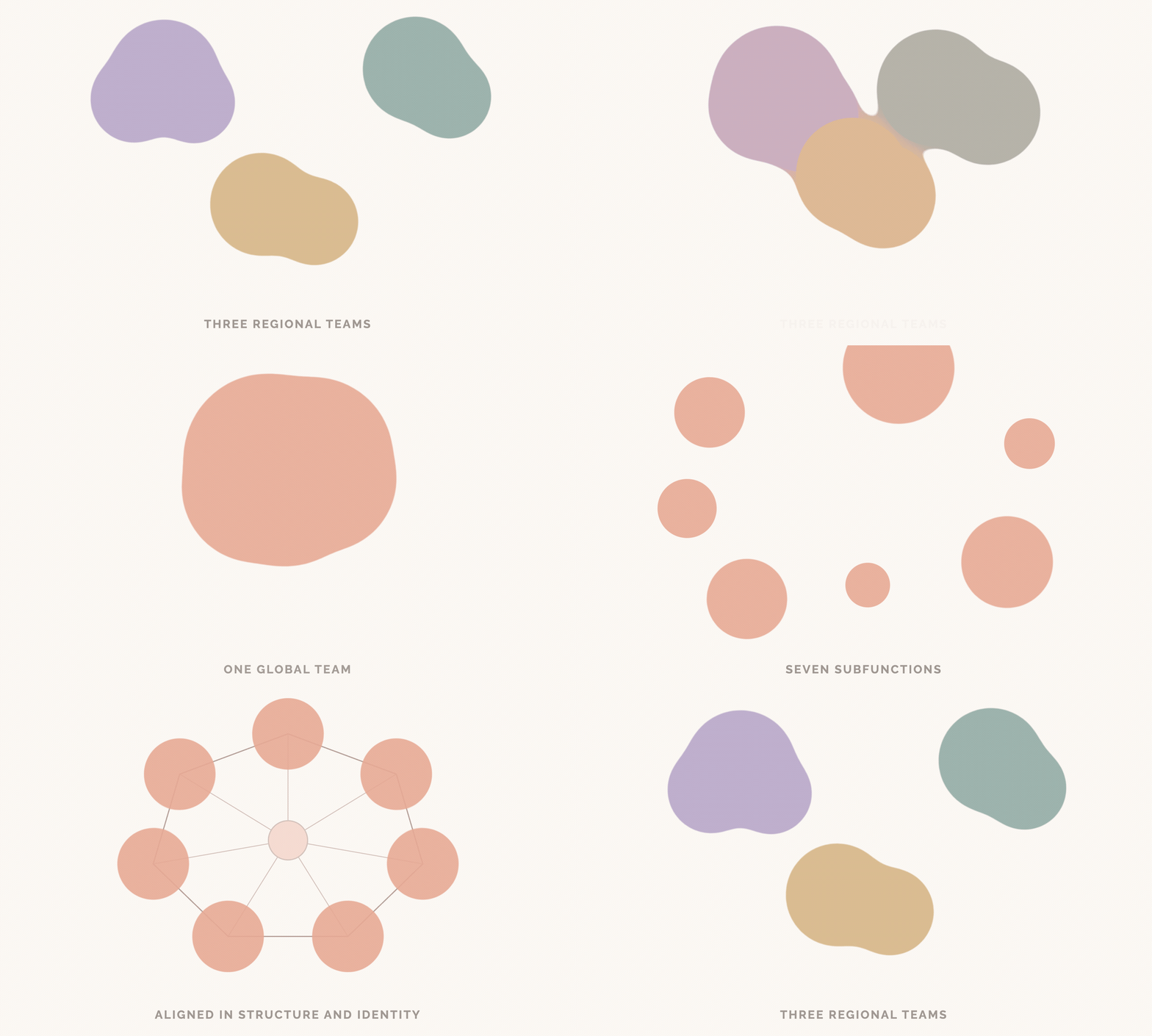
Three geographically distinct teams merged into seven new subfunctions built around specialised competencies. Most people found themselves in a team that hadn't existed before, with colleagues they hadn't worked closely with, doing work that was newly defined.
The operational challenges were predictable and largely addressable:
- Clarifying subfunction mandates and reducing overlap
- Establishing shared decision-making norms across functions
- Building communication channels that crossed old geographic lines
The harder problem underneath all of this: People didn't know how to talk about the organisation they were now part of. New joiners arrived with no coherent account of what the design org was, where it sat, or how their subfunction related to the others. Existing members were improvising their own explanations in ways that varied considerably depending on who was telling the story. Without a shared narrative, the identity work the reorg needed couldn't happen.
Insight
Identity in organisations is largely built through the stories people tell each other. Leaving those stories undesigned makes them inconsistent — shaped by whoever happens to be in the room and their own interpretation of what happened.
Why onboarding was the right lever
The existing onboarding had a specific problem: it was practical but siloed. Each subfunction ran its own version, focused on logistics and function-specific content, with no shared layer about the organisation as a whole.
What was missing:
- Any consistent account of the org's identity and mission
- Cross-functional visibility (people understood their team but not the whole)
- Standardised material for managers and buddies retelling the org's story
Every buddy conversation, every manager introduction, was a slightly different version of the same story, shaped by whoever was doing the telling. Onboarding is one of the most reliable mechanisms by which an organisation's self-image gets transmitted. Leaving it undesigned meant the org's identity fragmented at the point of contact with every new joiner.
What I built
A five-stage onboarding structure
The redesign added a dedicated XD Org Intro layer (Stage 2) sitting between administrative fundamentals and subfunction-specific content. The sequencing was deliberate: before a new joiner learned what their particular team did, they received the same orientation to the whole organisation that every other new joiner received.
| Stage | Focus |
|---|---|
| 1. Fundamentals | Systems access, buddy assignment, basic orientation |
| 2. XD Org Intro | Org identity, mission, all subfunctions, peer functions, how we work together |
| 3. My Function Team | Subfunction-specific content, team, projects, practices |
| 4. Prep for Success | Role-specific training, success expectations |
| 5. First Project | Introduction to first project, key relationships |
Stage 2 covered the design org's position in the broader company, its mission (raising design maturity, and the reasoning behind why that mattered), the leadership team and structure, an introduction to all subfunctions (not just the one they joined) and how the org collaborated across functions.
It also mapped the org's place in the wider ecosystem: who the peer functions were, how the design org related to them, and what collaboration looked like in practice. The intent was coherence at every level: internal structure, cross-functional relationships, and broader organisational context. My hypothesis was that the more clearly people understood their place, the more confidently they could interact with everyone around them.
A co-designed process
Rather than drafting something and distributing it, I ran conversations with the leads first — understanding what each function wanted new joiners to know, what felt missing, what the org's story sounded like from their vantage point. The draft incorporated their input, went back for co-editing, then was used to train both leads and their people managers before it touched a new joiner. By launch, the leads had contributed to and could speak to the narrative naturally.
Delivery at two levels
- Monthly combined online session: XD org-wide matters, facilitated centrally. The shared narrative told consistently, regardless of geography or which lead happened to be available.
- Subfunction-specific sessions: Led by the relevant leads, within a standardised format. Function depth preserved; structure consistent.
Permanently accessible materials
All onboarding content was housed in a shared documentation space, searchable and structured for ongoing reference, not just the initial joining period.
Insight
The decision to standardise a centrally facilitated org-wide narrative, while leaving subfunction content to the leads was key to keeping the shared story consistent while preserving function-specific depth.
What happened
The onboarding materials became the org's canonical self-narrative, which was an outcome beyond the original brief.
Existing members, not just new joiners, returned to the materials when they needed to explain the organisation to others: a new project partner, an unfamiliar stakeholder, a colleague who had been on leave during the reorg. The documentation became one of the most consistently visited parts of the org's knowledge base.
The redesign had done something more durable than improving first-week experience. It had formalised the narrative members used to make sense of and explain their organisation. And because that narrative was standardised, the explanations people gave each other became more consistent. Identity is partly what people say an organisation is when asked. The redesigned onboarding gave them a shared answer.
Scope note
The onboarding work was the most specific and consequential piece of a broader effort that also included:
- establishing decision-making norms across subfunctions
- building shared communication and documentation standards
- supporting managers through leadership transitions, and
- coordinated the org's first global offsite as a cohesion-building moment.
Strategic takeaways
Identity work happens through the stories people tell each other.
The reorg created a new structure. A shared sense of what that structure meant required deliberate narrative design — a consistent, accessible, repeatedly-told account people could actually use.
Onboarding is identity infrastructure.
The standard view optimises for speed-to-productivity. Treating it as the primary mechanism for transmitting organisational identity produces different design choices about what goes in, in what order, and who facilitates it.
Co-ownership makes transmission more reliable.
Leads who had contributed to the onboarding narrative told it better than they would have told something handed to them. The collaborative design process produced more fluent storytellers, not just more aligned documentation.
The document people return to becomes the canonical version.
Building something coherent enough that people voluntarily consult it beyond its original context is a different standard than building something adequate for its immediate purpose.
This work involved collaboration across subfunction leads, regional teams, and organisational leadership from 2021–2024. The organisation described here no longer exists in this form — it was restructured again in the years since, and most of the people involved have since moved into different roles, teams, or companies entirely.